FGM: a costly, organised crime against women and girls
Despite the physical horrors of FGM, why does it prevail? Hilary Burrage explains how often women are left with the worst of choices in the world’s poorest communities
A ‘bride price’ can guarantee economic survival, with FGM the brutal ‘pre-nup’.
Photograph: Alamy
Female genital mutilation (FGM)
is big business. It’s trans-global and sometimes organised by
centuries-old formal agencies, on a for-profit basis. Like most other
efficient businesses, it markets itself as in the interest of the
consumer, into whose lifestyle expectations it is firmly embedded.
These observations imply no disrespect for the immense suffering
which FGM causes. Across the globe there are probably 200 million women
and girls now alive who have experienced (and survived) FGM.
Cutters are often paid. Until recently nearly all excisors were
medically untrained, but increasingly, excision is undertaken by
qualified clinicians, giving FGM in the eyes of some, a veneer of
respectability. The World Health Organisation regards the medicalisation of FGM as the greatest threat to its final eradication.
FGM boosts low-paid medical workers’ incomes, and attracts kudos and
power for traditional excisors in communities where other high-status
work is hard to come by.
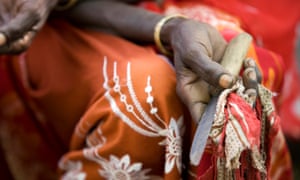
A cutter holding the tool she used to perform FGM in Afar, Ethiopia. Photograph: UNICEF/HOLT/EPA
Horrific gateway to the adult world
In some areas of Africa, deeply rooted ‘tradition’ demands that local
girls undergo FGM, and sometimes other harmful traditional practices (beading, breast ironing etc), if they are to gain access to a husband and the adult world.
Without FGM they are considered ‘unclean’; perhaps they will be cast
aside from their community. The economic prospects for the girl and her
family (as they will receive no bride price) may be as dire as those of
the excisors, if FGM is abandoned.
Cost to women
Advertisement
An
estimated 10-30% of those who undergo FGM may die from it, either
directly because shock, haemorrhage or infection, or from further
complications when giving birth. Infants whose mothers die or cannot
care for them have a much higher likelihood of dying as well. Women’s
much needed contributions to the local economy, of labour and
enterprise, are lost.
Then there’s the difficult question of land.
In some traditional African communities women own land in their own
right. But women who have not had FGM may be refused adult status, and
so the land may go back to their menfolk. Instead of becoming modern
citizens by refusing mutilation, women may therefore be reduced to the
status of chattels.
Diaspora: a marriage at what cost?
In western societies FGM may itself cause the very outcome it is
intended, back ‘home’, to avoid. Girls experiencing FGM in places such
as the UK may, like their African counterparts, withdraw from school, especially as they reach puberty, resulting in an alienation from mainstream society.
Given the huge human and hidden fiscal costs of not addressing FGM in
the developing world, should UK Aid be conditional, in those countries
most affected, on solid evidence that FGM is being tackled by the
domestic authorities?
Demanding an end to FGM would hit several universal targets,
including health, efficient use of funds, and human rights. It could be
more feasibly achieved by developing world national governments than
putting an effective stop to corruption or re-couping lost tax.
Somehow, the message has to be brought home, that FGM is a very
costly crime. Ultimately, that can only happen if those in governments
and international agencies with the most influence, are willing to speak
out and provide real leadership. Has anyone done the math? www.hilaryburrage.com
Future Milestone
Phasellus facilisis convallis metus, ut imperdiet augue auctor nec. Duis at velit id augue lobortis porta. Sed varius, enim accumsan aliquam tincidunt, tortor urna vulputate quam, eget finibus urna est in augue.



 Posts
Posts


No comments:
Post a Comment
Comments are discreet